
4 min read

Life rarely follows a straight line. A new job, a move, a health scare, a marriage, a divorce, or the loss of a loved one can change things quickly. That’s why getting your affairs in order isn’t just something “older” or “wealthy” people do — it’s a practical step for adults at every stage of life.
Still, many people put this off. According to the 2025 Trust &Will Estate Planning Report, while more than 80% of Americans say estate planning is important, fewer than one-third actually have a will or estate plan in place. That gap is often fueled by a few common myths.
Let’s clear those up.
Myth #1: “I’m too young to worry about this.”
Unexpected events don’t wait for a certain age.
It’s easy to think getting your affairs in order is something to handle later in life. But unexpected events don’t wait for milestones.
Research from the Pew Research Center shows that younger and middle-aged adults are much less likely to have basic documents in place — even though illness, accidents, and family changes can happen at any age.
Getting your affairs in order isn’t about anticipating the worst. It’s about naming trusted decision-makers and organizing key information, so others know what to do if something unexpected happens.
Myth #2: “I don’t have enough assets for a plan.”
This is often about decisions, not dollars.
Many people think getting their affairs in order is only relevant if they have significant assets. In reality, it often focuses on practical questions, such as:
-
Who could make medical decisions for you if you can’t
-
Who could manage bills or your accounts temporarily
-
Where important information is kept and how to access it
Don't forget about planning for other "smaller" assets, like ensuring your beloved pets are cared for when you're gone. The National Institute on Aging emphasizes organizing documents and naming decision-makers as a starting point — regardless of income or net worth.
Myth #3: “Everything will automatically go to my family.”
Good intentions don’t always translate into clear direction.
Some people assume state laws will sort things out smoothly. But state laws vary by state, and they may not reflect your wishes or family dynamics.
A client recently was named the beneficiary to her elderly mothers accounts. Her mother didn't name any specific beneficiaries in her plan, with assumption that our client would be the one to portion and distribute the assets appropriately among herself and her siblings. We find a lot of people make this assumption, but it can lead to a lot of arguments, and in this particular clients case, resulted in significant tax consequences too.
Without clear documents, decisions are often delayed, costs can increase, and loved ones may face added stress. Research on estate administration shows that lack of preparation can lead to longer administrative timelines and higher expenses — even for relatively simple situations.
Clear documentation helps reduce uncertainty, even though no plan can eliminate it entirely.
Myth #4: “This is only about end-of-life planning.”
These documents are often most useful during life.
Getting your affairs in order isn’t only about what happens at the end of life. It can be just as important during major transitions, such as:
-
Health changes
-
Caregiving responsibilities
-
Divorce or remarriage
-
A move to another state
Documents like powers of attorney and health care directives are designed to help during those moments, not just later on.
Myth #5: “Once it’s done, I never need to revisit it.”
Plans should change as life changes.
Marriage, divorce, children, a new business, or a move to another state are all reasons to review documents. Even without major changes, it’s wise to check in periodically to be sure information and beneficiaries are still current.
Think of this as ongoing maintenance, not a one-time project.
 Myth #6: “This will be overwhelming.”
You don’t have to do everything at once.
Many people feel stuck because they think they need to do everything at once. A more practical approach is to start with organization:
-
List important documents
-
Identify key contacts
-
Note where information is stored
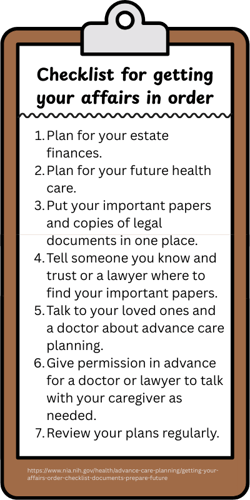
The National Institute on Aging’s checklist offers a practical, step-by-step place to begin.
Myth #7: “I’ll deal with this when something happens.”
Decisions made under pressure are rarely easy.
Waiting often means decisions are made during stressful moments, when options feel limited. Being organized ahead of time allows loved ones to focus on what matters most, rather than searching for information or guessing what you would have wanted.
A Thoughtful First Step
Getting your affairs in order is a personal process. What makes sense for one person or family may not be right for another, and priorities often change over time.
At Clute Wealth Management, our conversations often begin with helping people understand their options and think through what matters most to them. If you’d like to talk through questions or learn more about how planning fits into your broader financial picture, we’re always open to a thoughtful conversation.
Helpful Resources
- Trust & Will 2025 Estate Planning Report - Reports show 83% see importance but only 31% have a plan. (Trust & Will)
- Pew Research Center — Estate Planning Experiences study - Insights into who has wills/ advance directives and who doesn’t. (Pew Research Center)
- National Institute on Aging — “Getting Your Affairs in Order Checklist” - Step-by-step documents to prepare. (National Institute on Aging)
- Life Changes: Getting Your Affairs in Order and A Guide for Survivors - Specific NY State resources. (NY State Comptroller's Office)
- How a Collaborative Financial Team Helps Your Family, Rain or Shine - Money and You Article, Clute Wealth Management.
- Why Having Disability Insurance Actually Protects Your Most Valuable Assets - Money and You Article, Clute Wealth Management.
- Your Financial Health Checkup - Money and You Article, Clute Wealth Management.
Christina Ubl, CFP®, CDFA®, CEPA®, is a co-owner of Clute Wealth Management in South Burlington, VT, and Plattsburgh, NY, an independent firm that provides strategic financial planning for individuals and small businesses in the Lake Champlain Valley region. Securities and advisory services offered through LPL Financial, a registered investment advisor, Member FINRA SIPC. For informational purposes only. LPL Financial does not offer legal or tax advice. Clute Wealth Management and LPL Financial are separate entities.